
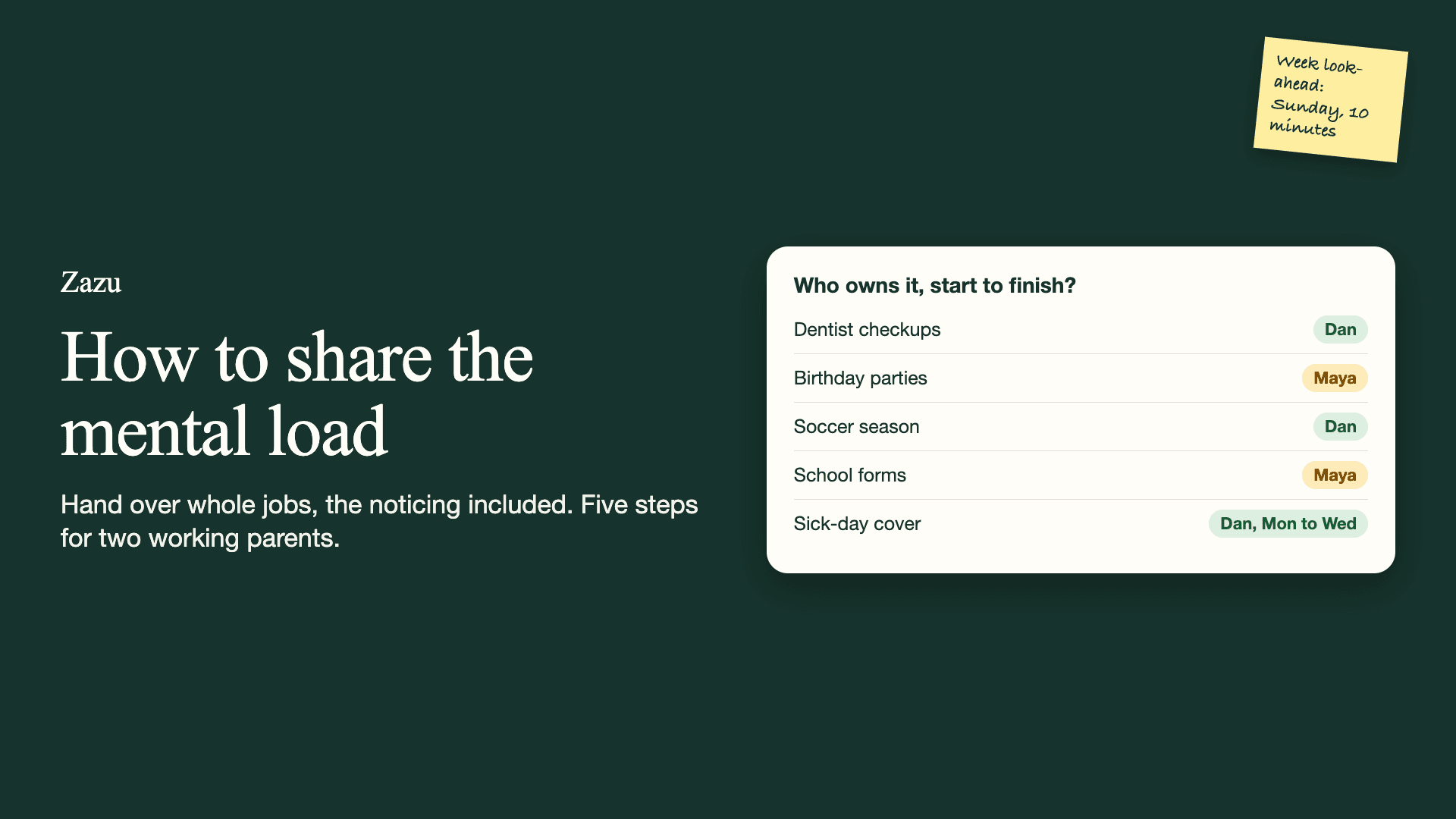
To share the mental load, split whole jobs, not chores. Each of you lists what it takes to run your home, including the thinking: noticing what is coming, finding the options, deciding, and checking it got done. Then give each job one owner from start to finish, move its emails, contacts and calendar entries to that person, and look at the week together for ten minutes. "Just tell me what to do" does not share the mental load. It leaves one parent managing the other. The work only moves when the noticing moves with it.
This is a how-to for two working parents who agree the split feels off and want a plan that lasts longer than a week. If you want the term itself first, start with what the mental load is. If you are not sure who carries it in your home, take the default parent quiz before you start.
What you are actually sharing
The mental load is easy to miss because most of it happens before and after the visible task. The sociologist Allison Daminger splits this cognitive labor into four steps: anticipating a need, identifying the options, deciding, and monitoring whether the choice worked. She interviewed 70 college-educated, married parents of young children, 35 couples. Deciding was overwhelmingly done together. Anticipating and monitoring were led more often by women, and in 26 of the 32 different-sex couples, the woman did more of the cognitive labor overall (Daminger's summary of her study).
That is why a split can look fair and still feel unfair. Say you pick a summer camp together. If one of you noticed in February that registration opens in March, found three options and later checked that the forms went in, "we decided together" hides most of the job. Daminger's advice to couples is to put cognitive tasks on the household "balance sheet" when you judge whether each partner is pulling their weight.
Eve Rodsky's Fair Play, a book from 2019, makes the same cut in different words. It started as a spreadsheet of the invisible tasks it takes to run a home and became a system of 100 household tasks, played as a figurative card game with your partner, with the conception, the planning and the execution of each task spelled out (the Fair Play cards). Execution is the part everyone sees. Conception and planning are the mental load.
Why "just tell me what to do" doesn't share it
Offering to help is kind, and it leaves the job where it was. The parent who has to say what needs doing has already done the anticipating and the identifying, and will still do the monitoring. National surveys show how lopsided that part is. In Pew Research Center's 2023 survey of 3,757 parents, 78% of married or cohabiting mothers said they do more than their partner to manage the children's schedules and activities. Only about one in ten fathers said they do more on tasks like these (Pew Research Center, 2023).
Partners also see the same home differently. Pew's 2026 survey of working parents asked couples where both parents work full time who would take time off if a child got sick or childcare fell through. 68% of mothers said they would be the one. Only 29% of fathers said their partner would. 40% of fathers, against 18% of mothers, said it would be about equal. Fathers were also much more likely than mothers to say the parenting and the chores are split about equally (Pew Research Center, 2026).
The same survey shows why the effort pays off. Among mothers in those couples who said they share the parenting tasks about equally, 65% were satisfied with how the tasks are divided. Among mothers who said they do more, 22% were. For household chores the gap was wider still: 54% against 11%.
How to share the mental load in five steps
Make two lists, separately. Each of you says who handles the jobs in your home, without seeing the other's answers. The fastest way is Who does it?, our free 60-second game for two: ten everyday jobs, each of you answers alone, then you see both pictures side by side. For a fuller list, the Mental Load Calculator covers 27 tasks in six areas in about three minutes. The places where your answers differ are the conversation.
Write the thinking into each job. For every job, name the four steps: who notices it is coming, who finds the options, who decides, and who checks it happened. "The dentist" becomes: notice the six-month mark, find a slot that fits both calendars, book it, and make sure someone takes the kid. Most couples find the noticing and the checking sit with one person even when the doing is shared.
Hand over whole jobs, one owner each. The owner carries the job from the first thought to the last check, which is what Fair Play means by conception, planning and execution. Swap jobs, not steps. A split like "I'll remind you, you book it" keeps the reminding parent as the manager.
Move the information with the job. In the same week you hand over a job, move its emails, contacts and calendar entries. Put the new owner's number on the school or activity list and change who gets the reminders. A job handed over without its information is just a new chore for one parent and a new thing to check for the other.
Look at the week together for ten minutes. Once a week, go through the next seven days: what is coming, who owns it, what is new. Decide the surprises in advance too. For sick days and school closures, agree who is on by weekday or by week; we wrote up how in who stays home when the kid is sick.
Where couples get stuck, and what helps
Different standards. The new owner will do the job differently. Agree once on what "done" means (the form goes in before the deadline, the lunchbox has a fruit in it), then let the method be theirs. Re-checking their work is monitoring, and monitoring is the very load you were trying to hand over.
The quiet hand-back. A job drifts back when the school keeps emailing the old owner or the coach keeps calling the same number. If a job you handed over keeps landing on you, look for the email list or contact sheet that never changed before you look at your partner. There is more on this in how to stop being the default parent.
Keeping score. You do not need a 50-50 count of jobs. Some jobs are heavier than others, and work schedules differ: in the same 2026 Pew survey, 70% of these parents said who has more flexibility at work is a major factor in deciding who takes time off when childcare falls through. Aim for a split you would both describe the same way. Play Who does it? again in a month. Fewer "nobody" rows and fewer surprises is what progress looks like.
Starting too big. Do not rebuild the whole household in one evening. Hand over one or two jobs this month, ideally ones with a clear start and end, such as birthday parties, the dentist or one sport's season. Leave the jobs nobody wants for a calmer week.
When the first message reaches both of you
Even after a good split, most of the mental load still starts in an inbox: the email about early dismissal, the invite for the class trip, the reminder from the pediatrician's office. Whoever reads it first becomes its owner by accident. That is the part we built Zazu, the AI family assistant for working parents, to take on. It works inside iMessage and WhatsApp, with no app to download. With your permission it reads the family's email and calendars, speaks up when something is coming, talks to both parents, and asks which of you is taking it, so each job lands with the parent who owns it instead of the one who happened to see it first. It always asks before it acts. Nothing to pay for 7 days. Then $19 a month. Cancel anytime: just send STOP.
How we checked: on October 20, 2026 we read each source on its own page: Allison Daminger in Behavioral Scientist (2019), Pew Research Center (2023 and 2026), and the Fair Play Policy Institute's card list and about page. The five steps are our advice, not a validated program. Spot a mistake? Email hello@getzazu.io.